English
-
Destinations
- Experiences
- Kilimanjaro
- Trip Ideas Skip to the content
Trip Highlights
What to expect on this trip
Hut Comfort, Mountain Challenge Marangu is the only Kilimanjaro route with permanent sleeping huts — a proper bunk, a dining room and a wash basin at each camp. The mountain still tests you; you just sleep indoors.
Five Climate Zones in Five Days Rainforest to moorland to alpine desert to glacial summit — Marangu compresses one of the most dramatic ecological sequences on earth into a five-day walk.
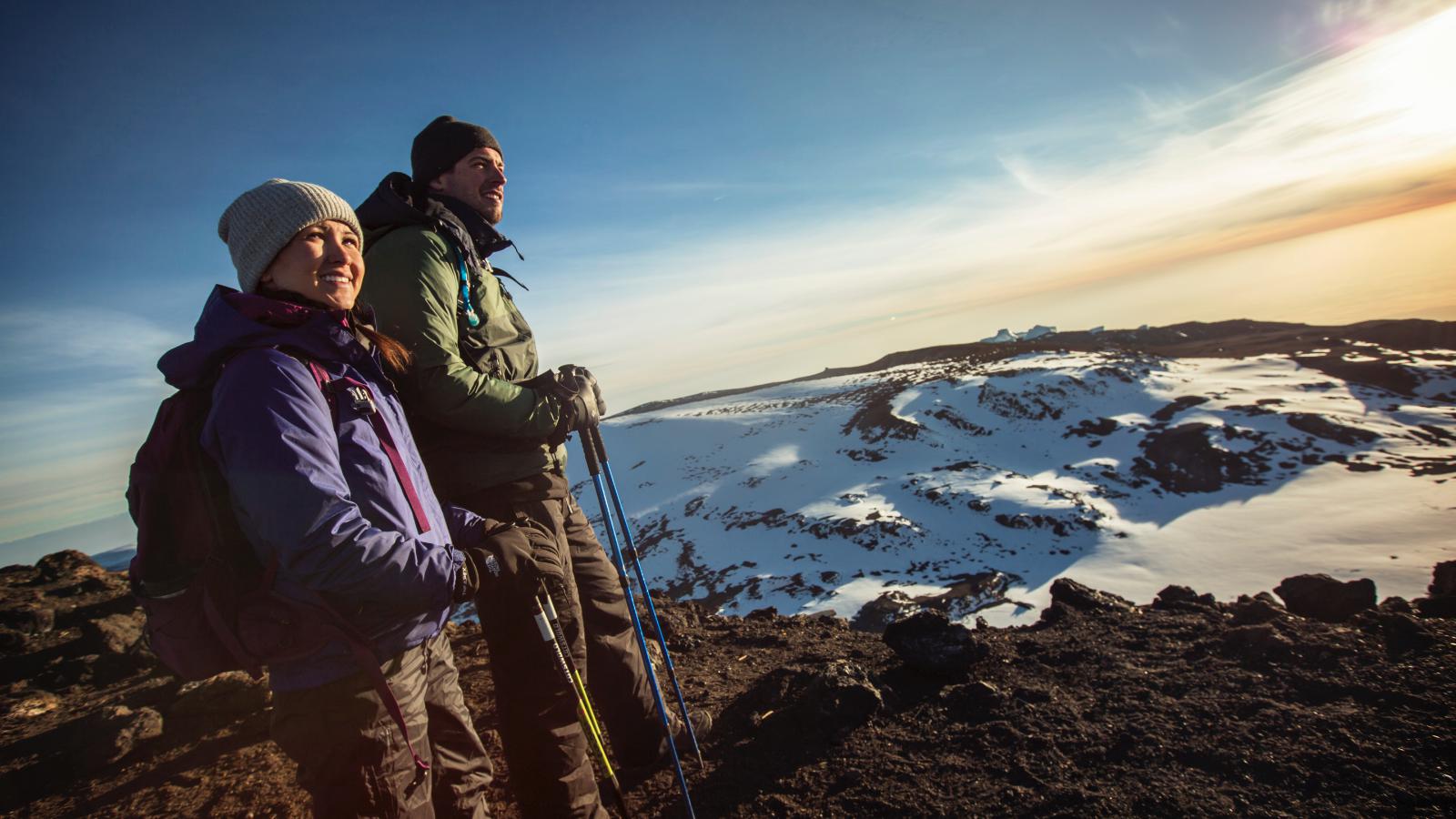
Gilman's Point & Uhuru Peak The summit push passes Gilman's Point on the crater rim at 5,685m before the final traverse to Uhuru Peak — the highest point in Africa — where the sunrise arrives as you do.
Certificate at the Gate Successful climbers receive an official KINAPA certificate at Marangu Gate on the descent: gold for Uhuru Peak, green for Gilman's Point. Your guides and porters are tipped and thanked here.
5 days
The Classic Marangu TrekFrom$ 1625 USDPrice per Person - Private Safari- Your Itinerary
-
01 Day 01
Marangu Gate (1,860m) → Mandara Hut (2,720m) | Rainforest · 8 km · 3–4 hours
Marangu Gate (1,860m) → Mandara Hut (2,720m) | Rainforest · 8 km · 3–4 hours
Your guide collects you from your hotel in Arusha or Moshi and drives to Marangu Gate, where the park registration is completed and the team assembled. The first day is the gentlest of the five — 8 km through dense equatorial rainforest over three to four hours, with a steady but never punishing gradient. The air is thick with humidity, the canopy alive with the calls of colobus and blue monkeys, and the trail surface soft underfoot. Mandara Hut arrives in the early afternoon — a cluster of wooden A-frame buildings in a forest clearing at 2,720 metres. If energy allows, a short side walk to Mundi Crater takes fifteen minutes and delivers your first open view across the plains below. Dinner is served in the communal hut dining room; the night is cool and quiet.
- Continue with the other day
-
02 Day 02
Mandara Hut (2,720m) → Horombo Hut (3,720m) | Moorland · 12 km · 5–7 hours
Mandara Hut (2,720m) → Horombo Hut (3,720m) | Moorland · 12 km · 5–7 hours
The forest gives way to heath and moorland as you climb out of the canopy and into open air. The landscape shifts to low shrubs, giant lobelias and tall groundsel plants — prehistoric-looking vegetation that defines this altitude band across equatorial Africa. Mawenzi Peak comes into view to the east, jagged and dark against the sky, while the Kibo dome rises ahead in the west. Today covers 12 km over five to seven hours, climbing from 2,720 to 3,720 metres — the longest day of ascent and the most important for acclimatisation. Horombo Hut is a larger camp than Mandara, often busy with climbers moving in both directions. The evening is cold, the stars bright, and the altitude noticeable for the first time. Sleep well — tomorrow the terrain changes again.
- Continue with the other day
-
03 Day 03
Horombo Hut (3,720m) → Kibo Hut (4,700m) | Alpine Desert · 9 km · 5–6 hours
Horombo Hut (3,720m) → Kibo Hut (4,700m) | Alpine Desert · 9 km · 5–6 hours
The moorland falls behind and the Saddle opens ahead — a broad, barren plateau connecting Mawenzi and Kibo at high altitude, where the wind is constant and vegetation all but disappears. Nine kilometres of alpine desert over five to six hours, climbing from 3,720 to 4,700 metres. The oxygen thins noticeably; your guide sets a deliberate pace and encourages slow, even breathing throughout. Kibo Hut is a stone structure at the base of the summit cone — functional, cold, and purposeful. You arrive mid-afternoon, eat an early dinner, and go to bed by seven in the evening. The alarm is set for midnight. Everything from here is about the summit.
- Continue with the other day
-
04 Day 04
Kibo Hut → Uhuru Peak (5,895m) → Horombo Hut | Summit Night · 21 km · 10–15 hours
Kibo Hut → Uhuru Peak (5,895m) → Horombo Hut | Summit Night · 21 km · 10–15 hours
Midnight. Tea and biscuits, then you step into the dark with headlamps and warm layers. The climb to Gilman's Point on the crater rim at 5,685 metres is the steepest and most demanding stretch of the route — volcanic scree in the dark, switchback after switchback, each step deliberate. Your guide leads, your porter follows, and the pace is measured to protect you from altitude sickness. It takes four to six hours to reach the rim. From Gilman's Point the crater rim walk to Uhuru Peak covers another two hours, passing massive glaciers in the early morning light. The summit at 5,895 metres is the highest point in Africa. Sunrise happens as you arrive. After photographs and a moment to take it in, the descent begins — back to Kibo Hut for brunch, then all the way down to Horombo, covering 21 km in total for the day. The lower altitude at Horombo brings the air back, and exhaustion is replaced by something that feels like relief and satisfaction in equal measure.
- Continue with the other day
-
05 Day 05
Horombo Hut (3,720m) → Marangu Gate (1,860m) | Forest Descent · 20 km · 5–7 hours
Horombo Hut (3,720m) → Marangu Gate (1,860m) | Forest Descent · 20 km · 5–7 hours
The final day is a long descent — 20 km over five to seven hours, dropping from 3,720 metres back to the gate at 1,860 metres. The moorland gives way to forest, the air thickens, and the warmth returns. Legs are tired but the trail is familiar and the mood is light. You pass through the same rainforest that opened the trek, now in full daylight and with the mountain behind you. At Marangu Gate you sign out of the park register. Successful summiteers receive their KINAPA certificates here — gold for Uhuru Peak, green for Gilman's Point. Tips for guides and porters are given at the gate before the drive back to your hotel in Arusha or Moshi.
- the end of your dream journey
Included
What's included
-
✓ Experienced mountain guide, cook and porter team throughout
-
✓ 4 nights hut accommodation (Mandara, Horombo ×2, Kibo) with all meals as specified
-
✓ All Kilimanjaro National Park fees, rescue fee and summit certificate
-
✓ Return transfers from Arusha or Moshi; bottled water and hot drinks on the mountain
Not Included
What's not included
-
✗ International flights, Tanzania tourist visa fees, and travel insurance (must cover high-altitude trekking to 5,895m)
-
✗ Tips and gratuities for guide, cook and porters
-
✗ Personal trekking gear (boots, warm layers, sleeping bag, trekking poles)
-
✗ Alcoholic beverages and any services not listed above
Get inspired
with your safari styleSpell-binding safaris paired with beachside bliss

Frequently Asked Questions
Travel Info at glance
WhatsApp ChatQuestions? Doubts?Chat with us via WhatsAppWe will respond as soon as possible. - Experiences