English
-
Destinations
- Experiences
- Kilimanjaro
- Trip Ideas Skip to the content
Trip Highlights
What to expect on this trip
Best Acclimatisation on the Mountain Seven days and the Lava Tower 'climb high, sleep low' profile give your body more time to adapt than any other standard Kilimanjaro route — directly improving your odds of reaching the summit.
The Shira Plateau Crossing Shira from west to east is a full-day walk across one of the world's highest plateaus — open, wind-swept, and unlike anything else on the mountain. Giant Senecio plants line the trail.
Barranco Wall Scramble The morning scramble up the Great Barranco Wall is the most dramatic section of the route — a non-technical but hands-on climb that rewards you with glacier views from the top.
Low Traffic, High Wilderness The Lemosho approach sees far fewer climbers than Machame or Marangu. The western forests and plateau feel genuinely remote, and camp evenings are quiet in a way the busier routes rarely achieve.
7 days
Kilimanjaro Lemosho Route 7-Day TrekFrom$ 2390 USDPrice per Person - Private Safari- Your Itinerary
-
01 Day 01
Lemosho Gate (2,100m) → Mti Mkubwa Camp (2,780m) | Rainforest · 7 km · 3–4 hours
Lemosho Gate (2,100m) → Mti Mkubwa Camp (2,780m) | Rainforest · 7 km · 3–4 hours
Your guide collects you from your hotel in Arusha or Moshi for the drive to Lemosho Gate on the mountain's western flank. Registration at the gate, then the trek begins in the undisturbed montane rainforest — a trail that feels far removed from the world below. The forest here is denser and less visited than the eastern approaches, with colobus monkeys in the canopy and forest birds calling from the undergrowth. Seven kilometres over three to four hours, climbing gently from 2,100 to 2,780 metres. Mti Mkubwa — Big Tree Camp — sits in a forest clearing where your crew has already set up tents and prepared the kitchen. Hot tea arrives as you settle in, and dinner follows as the forest cools around you. The first night on the mountain is quiet, green and unhurried.
- Continue with the other day
-
02 Day 02
Mti Mkubwa (2,780m) → Shira 2 Camp (3,900m) | Moorland & Plateau · 14 km · 7–8 hours
Mti Mkubwa (2,780m) → Shira 2 Camp (3,900m) | Moorland & Plateau · 14 km · 7–8 hours
The longest day of the trek in both distance and duration — 14 km over seven to eight hours, climbing from forest into the open heath and across the Shira Plateau to 3,900 metres. The forest canopy falls away as you gain the Shira Ridge, and the plateau opens up: a vast, wind-exposed landscape of prehistoric Senecio plants, scattered rock and enormous sky. You pause at Shira 1 for lunch before continuing east across the plateau to Shira 2 Camp. The afternoon light on Kibo from Shira 2 is exceptional — the summit cone rises directly ahead, close enough to seem reachable, far enough to remind you there are still five days to go. Dinner is three courses; the evening is cold and clear.
- Continue with the other day
-
03 Day 03
Shira 2 (3,900m) → Lava Tower (4,640m) → Barranco Camp (3,960m) | Alpine Desert · 7 km · 6–7 hours
Shira 2 (3,900m) → Lava Tower (4,640m) → Barranco Camp (3,960m) | Alpine Desert · 7 km · 6–7 hours
Today applies the mountaineer's rule: climb high, sleep low. You ascend from 3,900 metres to Lava Tower at 4,640 metres — a massive volcanic plug rising from the alpine desert — where lunch is taken at altitude. The exposure here is significant, and the acclimatisation benefit is real: your body registers the high altitude while you still descend to sleep. Seven kilometres over six to seven hours, but the elevation profile makes it feel longer. The descent into Barranco Valley is one of the visual highlights of the route — giant lobelias line the path as it drops into a sheltered valley directly beneath the Great Barranco Wall and Kibo's hanging glaciers. Barranco Camp is the most dramatically positioned site on the mountain. You arrive in the late afternoon; the wall looms above you in the fading light.
- Continue with the other day
-
04 Day 04
Barranco Camp (3,960m) → Karanga Camp (4,035m) | Wall Scramble · 5 km · 4–5 hours
Barranco Camp (3,960m) → Karanga Camp (4,035m) | Wall Scramble · 5 km · 4–5 hours
The morning begins on the Barranco Wall — a hands-and-feet scramble up a steep rock face that looks more serious from below than it is in practice. The route is well-worn and non-technical, but the exposure is real and the views from the top, looking back down into the valley and across to Mawenzi, are among the finest on the route. Five kilometres over four to five hours, including the wall and the ridge traverse that follows. Karanga Camp sits in a sheltered valley at 4,035 metres. It is a shorter day by design — a rest stage that lets your body consolidate the gains of the previous three days before the push to high camp. The afternoon is free, the views of Kibo's southern face filling the sky to the north.
- Continue with the other day
-
05 Day 05
Karanga Camp (4,035m) → Barafu Camp (4,640m) | Base Camp · 4 km · 3–4 hours
Karanga Camp (4,035m) → Barafu Camp (4,640m) | Base Camp · 4 km · 3–4 hours
A short day in distance — 4 km over three to four hours — but one that demands respect. You join the Mweka trail and climb through scree and silence into the afro-alpine desert, where the landscape is reduced to rock, wind and altitude. Barafu Camp sits on a narrow ridge at 4,640 metres: your base camp. The tents are pitched on a slope, the wind is persistent, and the summit is visible directly above. The afternoon is spent preparing kit, drinking fluids, and eating a light early supper. Guides brief you on the night ahead: the pace, the route, what to expect at altitude. Lights out by six. The alarm sounds at midnight.
- the end of your dream journey
-
06 Day 06
Barafu (4,640m) → Uhuru Peak (5,895m) → Mweka Camp (3,080m) | Summit Night · 18 km · 12–15 hours
Barafu (4,640m) → Uhuru Peak (5,895m) → Mweka Camp (3,080m) | Summit Night · 18 km · 12–15 hours
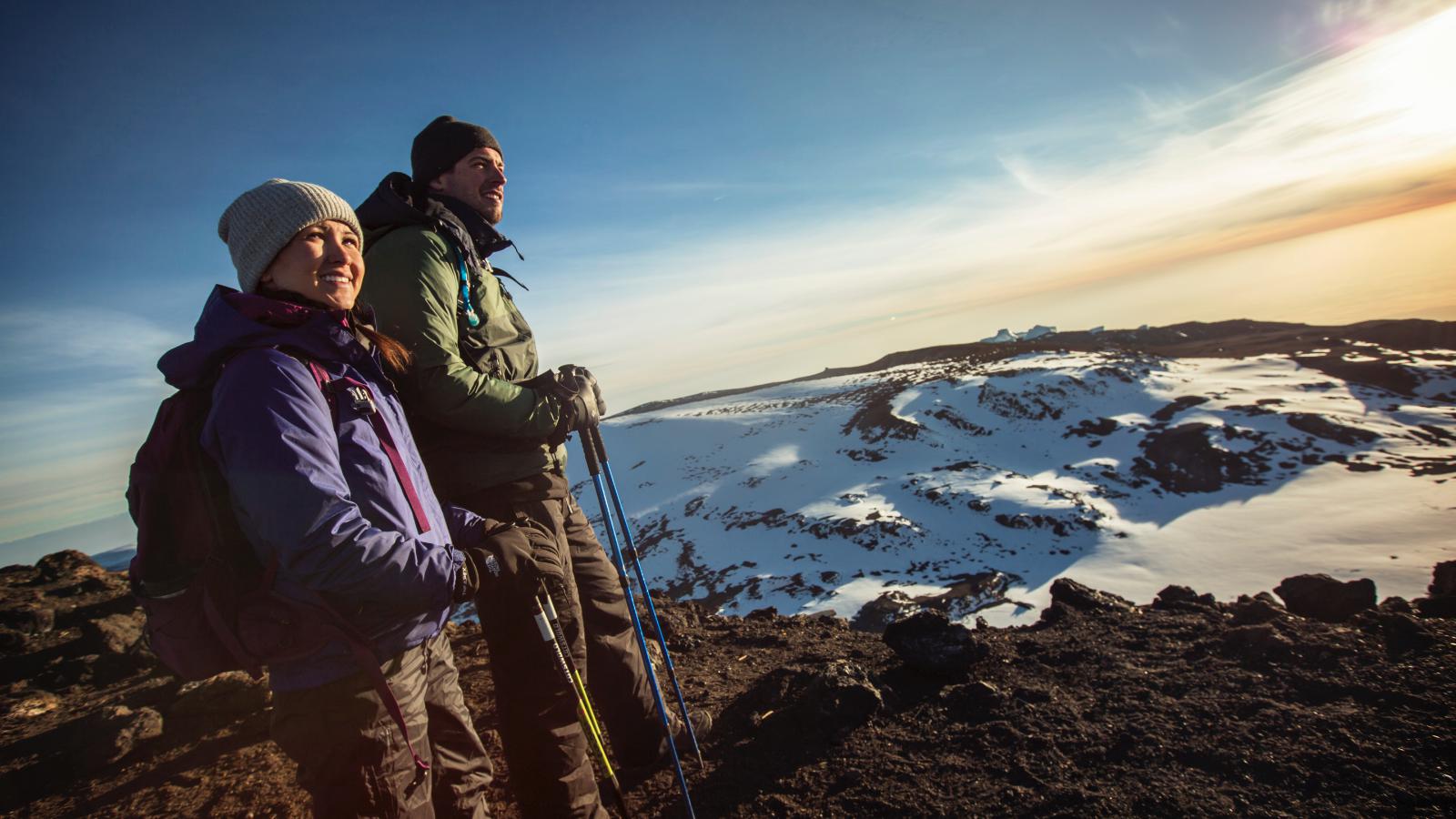
Midnight. You leave Barafu in the dark, headlamps picking out the scree path as you begin the long zigzag toward the crater rim. The cold is serious at this altitude — layers, gloves, face cover. Your guide sets the pace: slow, even, deliberate. Stella Point on the crater rim at 5,756 metres arrives after five to seven hours of climbing. The sunrise is happening as you crest the rim, and for a moment you stop and take it in. From Stella Point the crater rim walk to Uhuru Peak takes another hour — a gentle traverse at 5,895 metres with the glacier on your left and the plains of Tanzania 4,000 metres below. The summit sign, the photographs, the moment of arrival. Then the descent: back to Barafu for a rest and hot food, then all the way down through the moorland to Mweka Camp at 3,080 metres — 18 km in total, 12 to 15 hours on your feet. The oxygen at Mweka feels like a reward.
- Continue with the other day
-
07 Day 07
Mweka Camp (3,080m) → Mweka Gate (1,640m) | Forest Descent · 10 km · 3–4 hours
Mweka Camp (3,080m) → Mweka Gate (1,640m) | Forest Descent · 10 km · 3–4 hours
The final morning begins with your porter and guide team performing the traditional Kilimanjaro farewell — a song that has marked the end of expeditions on this mountain for decades. Then the descent: 10 km through the returning forest over three to four hours, knees absorbing the downhill as the air thickens and the warmth of lower altitude returns. The forest that felt distant and abstract on day one is now recognisable and welcoming. Mweka Gate. You sign the register for the last time, receive your KINAPA summit certificate — gold for Uhuru Peak — and tip your team. Seven days, 5,895 metres, one summit. Your driver takes you back to Arusha or Moshi, and the mountain recedes in the rear-view mirror.
Included
What's included
-
✓ Experienced mountain guide, cook and full porter team throughout all 7 days
-
✓ 6 nights tented camp accommodation with all meals as specified daily
-
✓ All Kilimanjaro National Park fees, rescue fee and summit certificate
-
✓ Return transfers from Arusha or Moshi; bottled water and hot drinks on the mountain
-
✓ Airport transfers (Kilimanjaro International or Arusha Airport)
Not Included
What's not included
-
✗ International flights, Tanzania tourist visa fees, and travel insurance (must cover high-altitude trekking to 5,895m)
-
✗ Tips and gratuities for guide, cook and porters
-
✗ Personal trekking gear (boots, warm layers, sleeping bag rated to -15°C, trekking poles)
-
✗ Alcoholic beverages and any services not listed above
Get inspired
with your safari styleSpell-binding safaris paired with beachside bliss
Frequently Asked Questions
Travel Info at glance
WhatsApp ChatQuestions? Doubts?Chat with us via WhatsAppWe will respond as soon as possible. - Experiences